Everything to know before you buy a used Discovery 5 — generations, engines, trims and what to check
The Land Rover Discovery 5, launched in 2017, represents the most refined and technologically advanced generation of the Discovery family. It's a very different ownership proposition to the Discovery 4 — this guide covers what to know before you buy, including the one update that matters more than any other: the facelift announced in November 2020, generally treated as the 2021 model-year update.
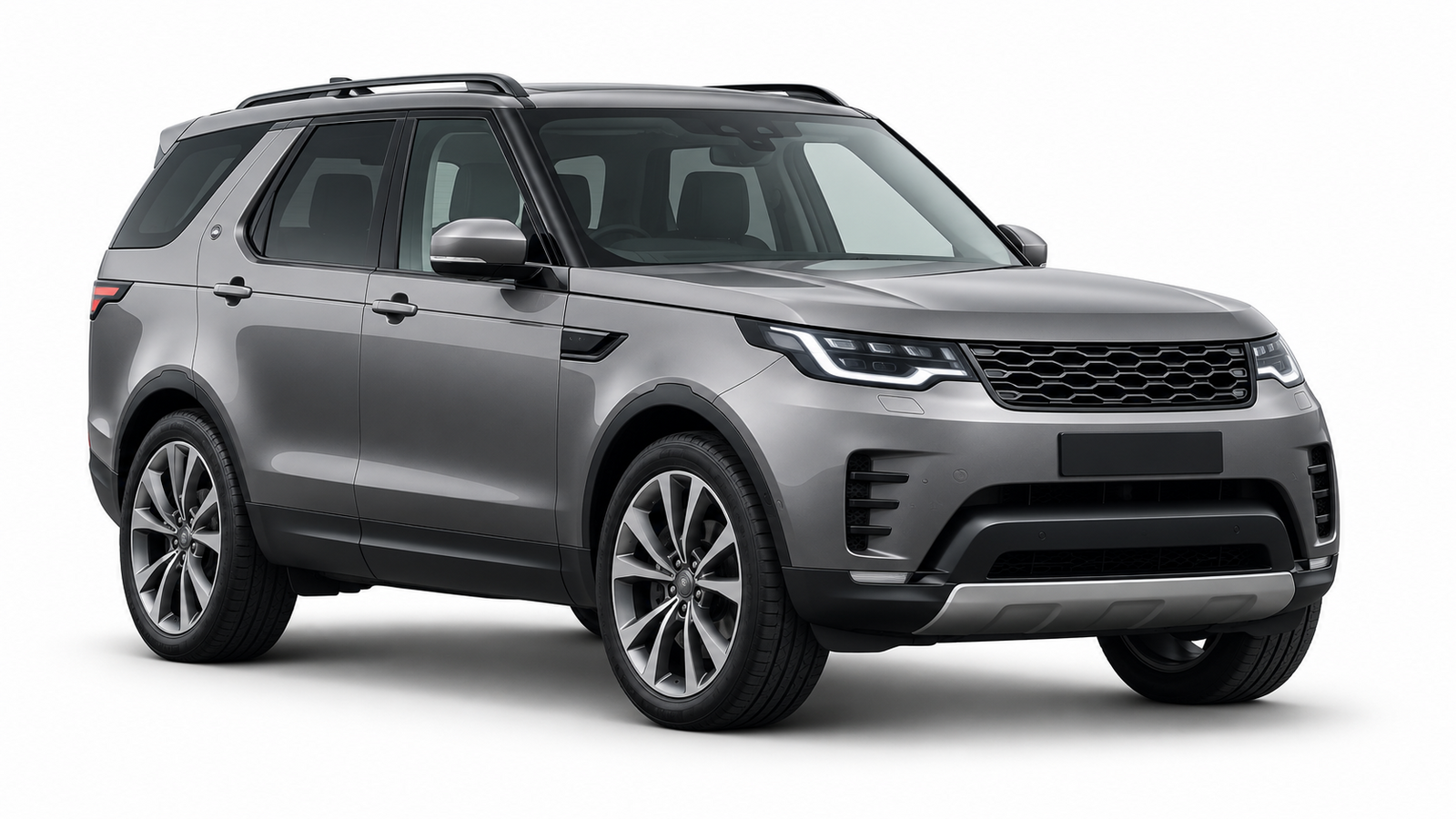
Illustrative promotional artwork — not a genuine OEM photograph.
This is the single most important thing to understand about buying a used Discovery 5.
For HMC's stock and value focus, the strongest opportunity remains a well-maintained 2017–2020 Discovery 5 with the 3.0-litre diesel engine. Early 2017–2018 examples can offer particularly strong value, while later 2019–2020 cars may command more because they are newer or better specified. The facelift introduced newer technology and the D250/D300 powertrain range, but facelifted vehicles usually cost considerably more — a high-specification, well-maintained pre-facelift 3.0-litre diesel may offer better value than a basic facelifted model. Compare specification, history, preparation, warranty support and price rather than assuming the newer model is automatically the better purchase.
| Engine | Power | Verified Years | Notes |
|---|---|---|---|
| 2.0L Ingenium Diesel (SD4) | 237-240 bhp | 2017+ | Common, efficient four-cylinder diesel |
| 3.0L TD6 / SDV6 | 255-306 bhp | 2017-2020 | Same six-cylinder diesel family, pre-facelift — badged TD6 early in this period, later redesignated SDV6 |
| 3.0L D250 / D300 | 249 / 300 bhp | 2021 launch through at least 2022 spec | Mild-hybrid, replaced the SDV6 at facelift |
| 3.0L P360 mild-hybrid petrol | 360 bhp | 2021 launch through at least 2022 spec | Less common on the used market |
| 2.0L P300 petrol | 300 bhp | Confirmed at 2021 launch; not listed in the 2022 spec we checked | Check the individual vehicle — availability beyond launch not confirmed |
The 3.0L six-cylinder engines (TD6/SDV6 and D250/D300) are generally the more relaxed, refined choice for towing and long journeys, while the four-cylinder Ingenium diesel/petrol options are the more affordable, efficient everyday choice.
HMC specialises in 3.0-litre diesel Land Rover Discovery models. We do not buy or retail the 2.0-litre diesel Discovery 5 as part of our core stock programme — the engine table above is provided for reference only and doesn't reflect what we actively stock.
For a broader look at fault areas across the whole Discovery range, see our common problems guide. Before you view a car in person, print our free 40-point Discovery buyer's checklist to help you work through these checks methodically.
The Discovery 5 costs more to service and insure than a Discovery 4, reflecting its complexity and newer technology — but the four-cylinder Ingenium diesel is notably more fuel-efficient than anything in the Discovery 4 range. See our running costs guide for a full breakdown.
If you're also considering a Range Rover Sport alongside the Discovery 5, our Discovery 5 vs Range Rover Sport comparison covers the key differences in practicality, price and character.
The Discovery 5 makes sense if refinement, technology and a more modern driving experience matter to you, and your budget stretches beyond Discovery 4 money. If value and mechanical simplicity matter more, our Discovery 4 vs Discovery 5 comparison will help you weigh up the trade-offs.
Every Discovery 5 we sell is independently inspected, software-updated and backed by our specialist knowledge.
